The Three Principles of Self-Understanding
Paradoxically, knowing yourself doesn’t happen in isolation.
While being alone with your mind is a feature of the process, it is just that: a feature. The process itself extends well beyond it, encompassing all the interactions you have with other people as well. This is because no being can exist without the other, as the social nature of our species ensures that to be the case.
Life is a single-player game, but meaning is derived on multi-player mode. You’re responsible for the actions you take, but the results of those actions will be shared amongst others. Everything you do contributes to the state of the world, irrespective of how large or small you think that impact may be.
A simple way to map this dynamic is in the form of this diagram:
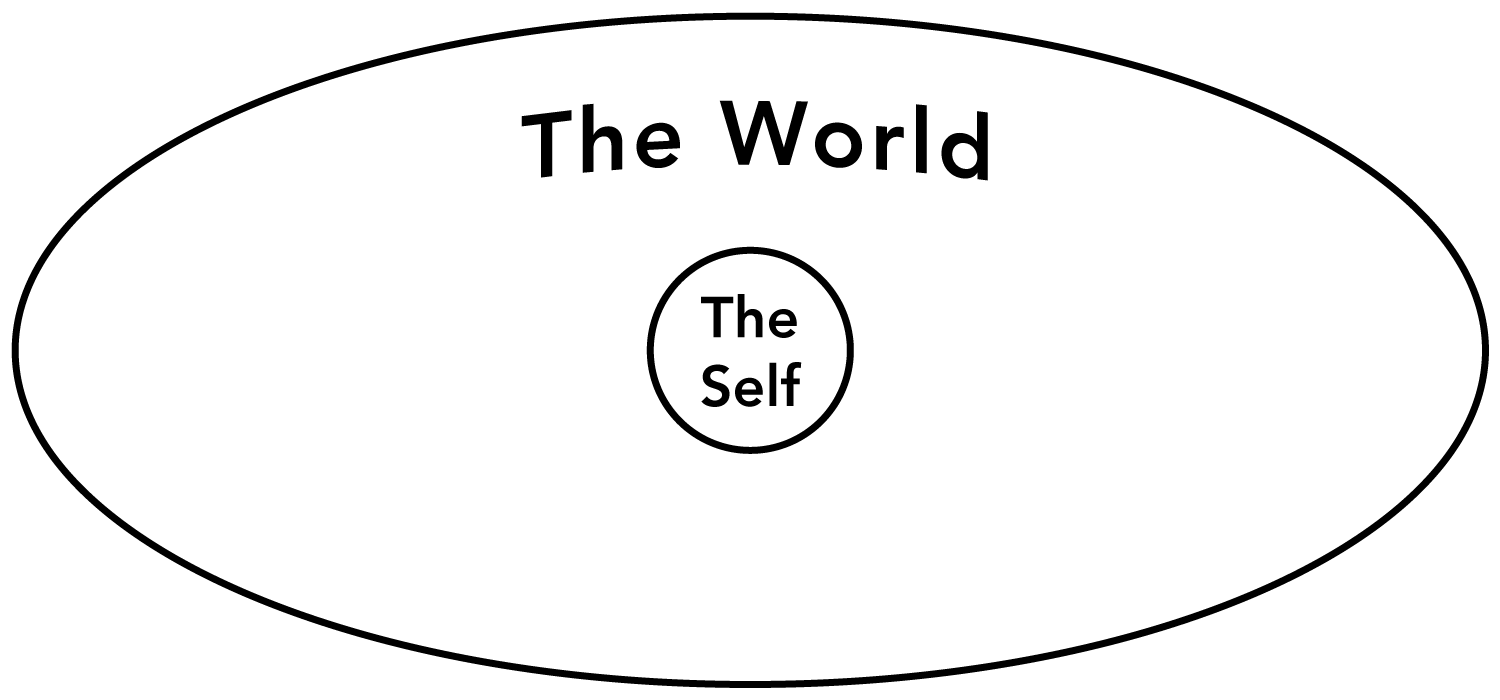
There is you, the self, that is a part of the greater world you inhabit. And much of self-understanding is about knowing how to function within this world while retaining conviction in who you are. Attaining this balance is the hallmark of what it means to know yourself.
It is with this context that I’d now like to share the three principles of self-understanding. They are:
- Reflect
- Relate
- Create
That’s it. Three simple words that house an abundance of detail.
Each principle touches upon a section of the “Self and the World” map shown earlier, as every component is necessary to comprehend. It is through the careful interplay of each moving part where you cultivate the stillness required to resist conditioning, which is the only way to dissolve suffering.
The rest of this chapter will provide a brief summary of each principle, while the rest of this book will explore them in greater depth. The details are what produce insight, but the overviews are what provoke curiosity. So with that aim in mind, let’s briefly review what each principle entails.
Reflect.

The foundation of your being has been built by other hands. Your genes, your parents, and your upbringing are the result of randomness, yet they are responsible for much of your worldview.
The first principle of reflection starts with the recognition of this fact, then attempts to take a bottom-up approach to the question of who you are. It’s an active exploration of the building blocks of your identity, an understanding of why they’re there, and the discernment of what to keep or replace. What results is the core of who you are, untouched by the winds of conditioning and free from the fog of fear.
To reflect is to study the self and to question what you find. And through this process, you’ll develop the conviction required to position yourself within the world.
Relate.

Relationship is a mirror. The way you view others will reflect the way you view yourself.
If you treat people as assets that serve your goals, then you will define yourself by what you produce. If you categorize people by status, then you’ll use your place in society to determine your self-worth.
Conversely, if you treat people with compassion, then you will be kind to yourself regardless of circumstance. If you are present with whoever you encounter, then you’ll retain contentment even when you’re alone.
To relate is to study the world and how you interact with it. And through this process, you’ll discover an unfiltered perception of who you are.
Create.

Creating is not a privilege reserved for the artistic few. It’s a birthright that we all have access to, and exercising it dissolves the boundary between you and the other.
Take a brief moment to look at your surroundings. Almost everything you see, from this book you’re holding to the contents of your environment, is the result of creativity. Creating and sharing is in the lifeblood of our species, and it is through this dynamic where we construct our reality and coexist within it.
To create is to express what you’ve discovered about yourself and the world. And through this process, you’ll harvest meaning from the experiences that have deep roots in your mind.

Reflect. Relate. Create.
In the pages that follow, we’ll explore each principle in sequential order, largely because each one feeds off its precedent. Reflection is the origin point because it’s only through questioning yourself where you observe your unconditioned core. By observing this core, you then gain clarity into the kinds of relationships that will brighten both yours and others. And by knowing what brightens yourself and others, you then create the very things that contribute to that shared brilliance.
Through this cycle, you strengthen your sense of purpose and gain a better understanding of who you are. And given that the journey of self-understanding has no endpoint, each step forward is yet another opportunity for reflection, which brings us back to where it all begins.
_______________

If you enjoyed this post, consider joining the More To That newsletter. You’ll be notified when a new post is up, and will get access to personal reflections that you won’t find anywhere else.
_______________
Related Posts: