The Poison of Status
When I was in college, I worked in an office for the first time. I wasn’t used to this setting, as none of my prior jobs required me to sit in a cubicle and produce tedious reports. But while I quickly acclimated to the reality of my boxed workspace, what I couldn’t get used to was something I observed amongst my colleagues:
The way their behavior changed depending on one’s social standing.
If Bob held a higher title than John, then Bob would speak with a nonchalantness (and oftentimes arrogance) that he would never exhibit to his boss, Jane. And while Jane would always show up early to meetings with her boss, she would casually show up 15 minutes late to meetings with other folks. This collective charade was everywhere, and while we have a term that localizes it to the workplace (“office politics”), the truth is that this dynamic permeates many of our interactions at large.
The force that drives this charade is status, and it’s our thirst for it that drives every game we play. It’s what makes people feel superior to others, which makes them also assume inferiority when it comes to people they admire. Status is always zero-sum in this way; your arrogance only stretches as far as your subservience. People that act like obedient dogs in the faces of their masters will be the first to bark orders in the faces of their servants. There are no equals in the mind of someone chasing status, which means that the world will look like a never-ending arena of competition and envy.
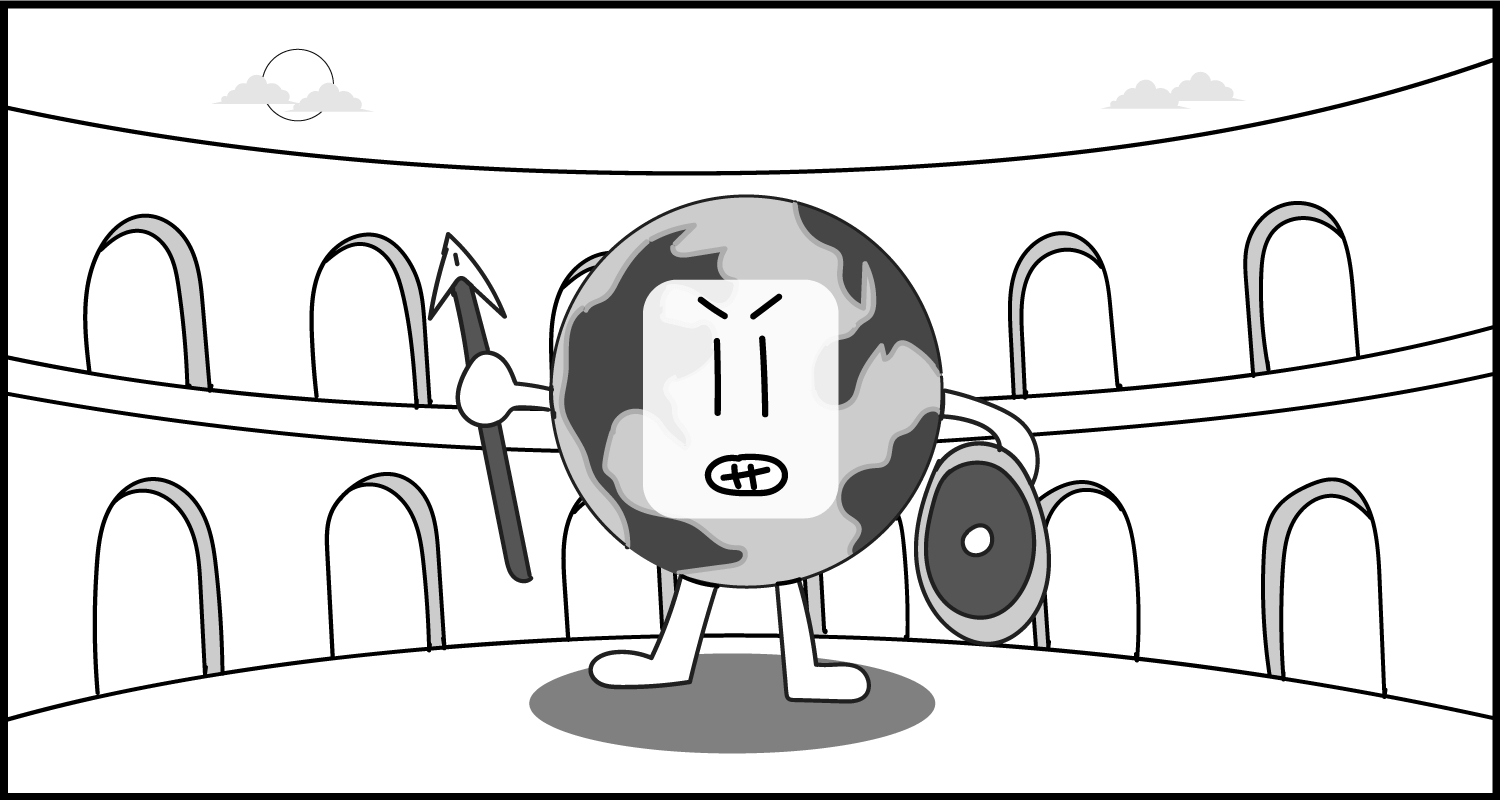
Now, some will attempt to justify our playing of status games by claiming that it incentivizes people to create great things. That if we didn’t shower people with money or recognition, they wouldn’t go on to produce the technological and cultural advancements that make this world a better place.
While this may make sense at first glance, you’ll realize just how flawed it is when you take a moment to sit with it.
If someone is incentivized by status to develop a technology, how plausible is it that the resulting product stems from the desire to increase the well-being of the world? Of course, that’s what the innovator may claim, but deep inside, the selfish attachment to one’s position will take precedence over everything.
Take social media for example. It’s been widely reported that social media has had disastrous effects on the population’s mental health, especially in our youth. If the people responsible for these tools were truly driven by the desire to create a better world, they would make sweeping reforms to ensure that their platforms never cause additional harm. But as you know, that rarely happens. Instead, they continue onward with their development, exploiting even more vulnerabilities in our psychology so they could maximize engagement and claim their place in the cultural zeitgeist. These people are not driven by the common good; they are driven by status.
The anthropologist Ernest Becker once wrote that we are “gods with anuses.” What he meant was that humans are equipped with godlike imaginations that can compose beautiful music, build towering skylines, and even send rockets into space. But at the same time, the biological container that houses this incredible mind has been inherited from our monkey ancestors. It is a body that defecates, secretes, and deteriorates until it ceases to function. The tension between what we’re capable of and what we’ve inherited is the core struggle of the human condition.
Status is one of those ugly things that we’ve inherited from our evolutionary ancestors, as the quest for dominance is seen throughout the animal kingdom. We all know this, yet our conditioning has convinced us to believe that it’s a worthy pursuit. It tells us that if you play the game right, you’ll get everything you desire. But of course, what you desire has also been planted by the game, ensuring that you’ll never be able to leave.
The solution is to do away with status, and to choose compassion instead. Compassion is the ability to extend full presence to people, regardless of who they are or what they’ve achieved. It’s to see that people are not defined by their proximity to your goals, but by the unity of the human experience. In the end, we all find our way to the soil or the sea, and that humbling fact makes you appreciate every person that accompanies you on this ride.
There are some that claim that viewing the world without the lens of status is impractical, and that you must play the game to achieve your goals. And to that I’d ask, “Who would you respect more: The person that strategically chooses who to appreciate, or the person that can do that for anyone?” The paradox of declining status is that there is a magnetism to it, and that manifests through the allocation of trust.

The people I admired most at the office weren’t the charismatic leaders that knew how to close deals. Rather, they were the few people that showed reverence for everyone, whether it was a potential client or the building custodian. They would know the names of all the cleaning staff and their family members, and would listen to them with the same presence they would have for their own boss. There were no motives to these dynamics other than being curious about the person in front of them, irrespective of who they were. That was my aspiration as well.
Krishnamurti said that “it is no measure of health to be well adjusted to a profoundly sick society.” When you see that this sickness is caused by our justification of status, then you’ll see just how healthy our relationships can be once you remove it. The immediate effect is that there’s a full embrace of the person in front of you, and there’s nothing you expect other than sharing that moment together. The long-term effect, which is even more profound, is that you start to embrace yourself without condition as well.
If the inner critic is a reflection of how you view others, then what happens when you no longer care about one’s status? Well, then you stop using your own place in society to determine your self-worth. You understand the frivolity of it all, and see the utter hollowness of using achievement as a barometer for acceptance. You redirect any external attention back toward your inner compass, and use it as the primary force to guide you.
This is why self-understanding is a communal affair. If reflection is the principle that reveals why you think the way you do, then relationship is the principle that helps you put those revelations in action. There’s a constant feedback loop between the self and the world, and this helps to refine your intuition over time.
But as you’ll recall, there’s one final principle to go over.
That’s because as your intuition is refined, you learn so many lessons from each adjustment that is made. And what makes the self and the world feel fluid is when you share everything you’ve picked up along the way. By doing so, you dissolve the boundary between you and the other, and connect in a way that neither reason nor logic can quite explain.
The only way this happens is through the age-old principle of creation, which will reveal more about your capabilities than anything ever can.
_______________

If you enjoyed this post, consider joining the More To That newsletter. You’ll be notified when a new post is up, and will get access to personal reflections that you won’t find anywhere else.
_______________
Related Posts: