A (Longer Than Expected) Look Into My Writing/Illustrating Process
Hey patrons,
Hope all is well! I realized that I haven’t written a patron-only post in quite some time, and given that you guys are the ones that care most about keeping More To That up and running, I thought I’d give you a peek into how I write the posts that were compelling enough for you to become patrons in the first place =).
But first, I wanted to give you a brief update on the next post I’m working on!
This post serves as a follow-up to the latest piece on natural selection and Resistance. If you recall, the last post ended with a tower of three unidentified adversaries that commonly represent Resistance, and I left the post with an open-ended analogy that compared the journey up this tower to that of a video game quest.
Well, this post carries that analogy forward, and really goes deep into who those adversaries are, how they could be beaten, and how we can ultimately make our way up to the Unlived Life. In fact, here’s a drawing of the “start screen” of the video game:

The post itself is shaping up to be one of the meatiest ones I’ve done thus far, and I’m excited about how it’s turning out. Right now I’m finishing up the writing part, and I’ve begun much of the illustrations – I don’t want to peg a “release date” or anything like that to it, but I will make sure you guys are the first ones to know when it’s up!
Okay, now onward to a look into my writing process.
I’m still experimenting with the best way to structure and write my posts, as I’ve only published 5 of them so far on the blog. However, I can share with you the method I’m currently using to shed some light on how each post goes from an idea to an entire thing that ultimately goes up on the site.
(1) Choosing The Topic
I’ve tried to build an “idea repository” that I could tap into whenever I need something to write about, but I’ve found that this method doesn’t really work too well for me. I’ve tried Evernote notebooks, Word documents, all kinds of stuff to act as a central thing, but as of now, I don’t really select something off of a bullet-pointed document of potential topics.
For the most part, I’ll just choose a topic that is really tugging at my brain strings for a sustained period of time, and I’ll run with it! This probably isn’t the best way to do it (assuming that there is a “best way” to begin with), but I find that going with what I really care about at a given moment is a good gauge of my interest and desire to expand upon that thought.
One thing I’ve realized through writing is that a lot of the time, there’s so much more going on in our heads about a certain topic than what we initially think is happening. For example, for my most recent post on natural selection, I knew that I broadly wanted to talk about why it’s so hard to do the things we know we should do, and that it has something to do with the battle between rationality and our biology. However, when I actually started writing the post, all these things that were previously on the periphery came into the forefront of my mind. That’s how a topic that started off as this vague idea of “decision misalignment” is now a two-part series that will be the meatiest thing I’ve written on More To That thus far.
There’s this quote by neuroscientist/author/podcast host Sam Harris that I really love, and it goes something like this:
“Writing is the technology of the mind.”
If there’s one thing I learned in this journey thus far, it’s that writing is such a crucial component of structuring and introducing different dimensions of depth into your thought process. Sure, you can read a great book, listen to an enlightening podcast, or watch a really interesting documentary, but I find that through these forms of learning, you end up retaining only a few key items, and discard the rest of the knowledge shortly thereafter.
With writing, it helps to solidify and unify these otherwise scrambled thoughts, and illuminates interesting insights you’ve gained, even if you were unaware then you even had them to begin with! That’s the coolest part about writing – sometimes when you’re done, you’ll take a look back at what you’ve written and think, “Holy shit, I didn’t even realize I thought through all these things like that!”
So yes, writing is certainly a technology that has been used for centuries, and for more and more years to come. I bring this all up because regardless of what idea I choose, I know that when I sit down to write about it, the mind will do this thing where it’ll just dig deep into the crevasses and pull out stories, analogies, etc. that I may have been previously unaware of. The subconscious is a wild thing, and writing can act as a bridge that takes you there.
(2) Outlining
Okay, call me “old school”, but there’s something I still really like about physically writing things down, with pen in hand. Yes, it’s time-consuming, so I don’t know if I’ll keep doing this, but I like to do my outlines by structuring and writing down a preliminary draft in a notebook.
I’ll jot things down to build the framework of the post – sometimes in full sentences and sometimes in gibberish – and will use it as a guide when I sit down to actually do the writing that will show up on the final version. Usually I will do this kind of outline for just a part of the post (as this will take me too long to do it for the whole thing), but I have done it for a whole post in the past.
Since we’ve been using the natural selection post as an example thus far, here’s what the scribbly outlines look like in the notebook:
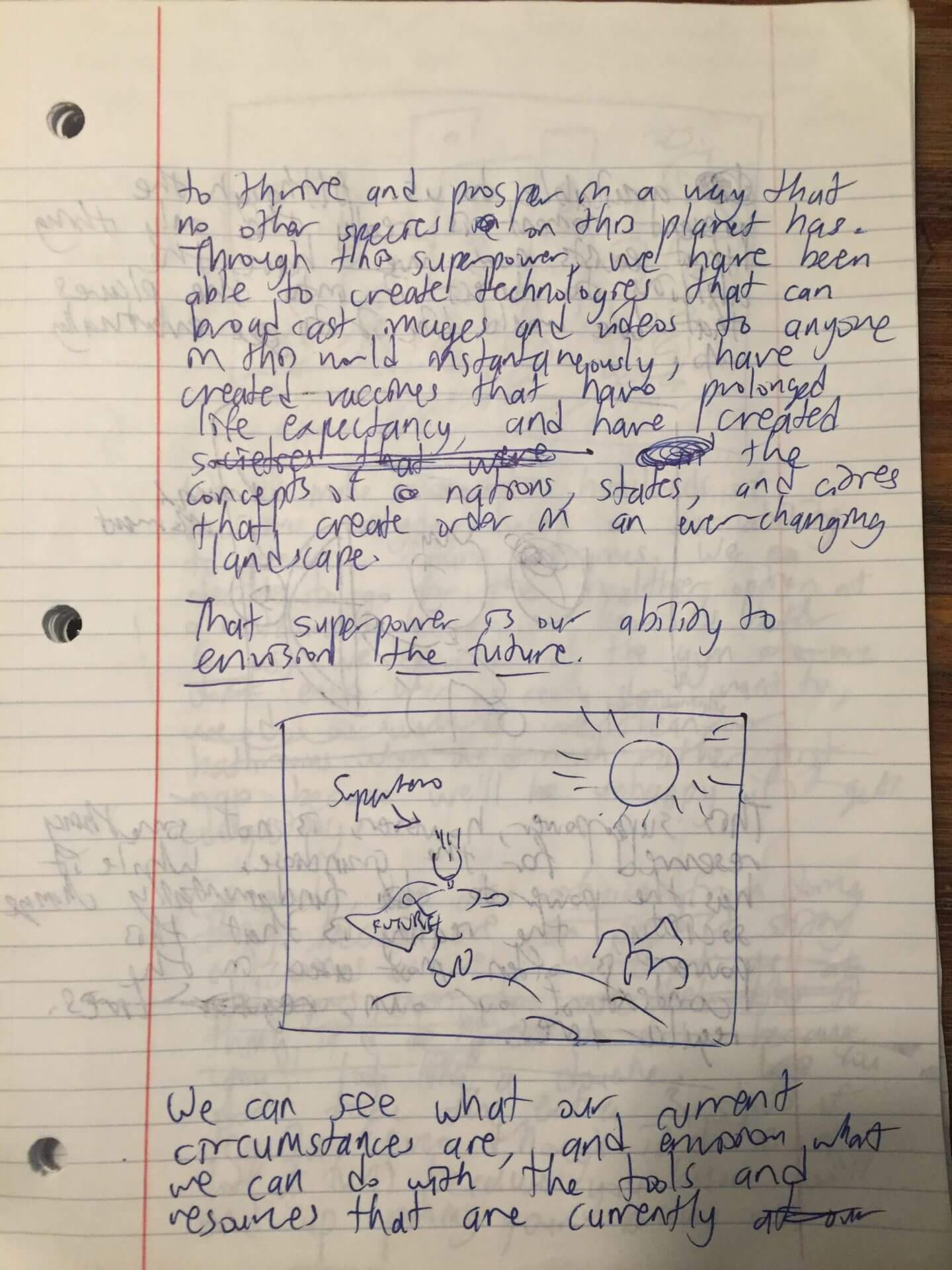
I’m still trying to figure out the best way of outlining – while this approach may work for posts that don’t require as much research, I can see how a post that needs me to copy/paste a lot of things from various articles/Wikipedia pages/etc. will require an alternative method.
As I said earlier, I usually won’t outline the whole post. The parts I generally do outline are the first couple sections, or the parts where the crux of the message can be convoluted and messy if I don’t take the time to structure my thoughts in a cohesive manner (the concept of mapping “attentional capital” and “amount of understanding” on a knowledge graph is one thing I can think of here).
Outlining is still an experiment for me, and I like to mess around with different methods depending on (a) the kind of post I’m writing, and (b) where my mind gravitates to at that given moment. Perhaps it may congeal into one concrete method in the future, but for now, I’m still trying to figure it out.
(3) Write!
In a post about my writing workflow, you had to wait until about 50% of the way down this Patreon post to get to the part about writing style. So… yeah…. thanks for your patience =).
So by this point, I have a general idea of the topic I want to write about, along with a loose outline of the structure/content I want to use for the post itself. With these two things in mind, I can sit down and start the actual writing process itself.
When I write, I use this program called Cold Turkey Writer, which has been amazing for me. It effectively turns your computer into a typewriter for either a set period of time or a designated word count, and you can’t do anything else with it during that time. No checking your email, your social media accounts, etc. w/your computer during this timeframe. I mean, technically, you can just grab your phone and start fucking around with it if you REALLY want to be unproductive, but then of course, you’d just be fooling yourself if your goal is to block out distractions and just write. So if this sounds compelling and you want to check it out yourself, there’s a free version of Cold Turkey Writer you can use that has all the features you need – get itttt!
At the end of each session, you can save what you’ve done as a .txt file. So after a bunch of writing sessions, I’ll get something for a post that looks like this:
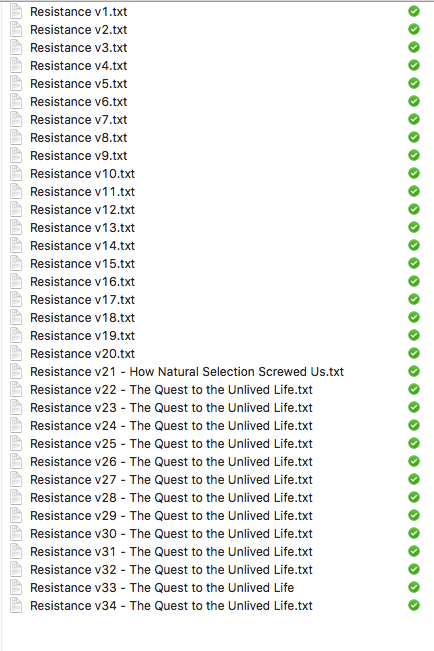
Another great thing about Cold Turkey Writer is that it auto-saves what you’ve done every 10 seconds into a .txt file in a specific folder (it’s in the Documents folder on the Mac – not sure about Windows), so you don’t have to freak out if your computer turns off on accident or the program crashes. If this happens, just go into that folder and grab the autosave .txt file (do this before opening up Cold Turkey Writer again, or else it overrides it!) to ensure that you’ve preserved your work.
All right, I realize that I’ve just sung Cold Turkey Writer’s praises for a significant part of this section, so let me go into a few things I’ve learned about the writing workflow over the last few months:
(1) Writing flows best when you’re engaged in what Cal Newport calls “deep work”. When you have eliminated distractions and are focused purely on what you are writing for a set period of time, your consciousness is then aligned with the very project you’re working on, and that sexy thing known as “flow state” can emerge in the process. Deep work is not about setting an 8-hour block of time that is filled with 15-minute blocks of sporadic work, lots of fucking around, idle time populated with distractions, and then another few blocks of work sprinkled in between. It’s about setting the intention of engaging in deep, sustained work for about 3-4 hours, with two or so intentioned breaks set in the middle of it.
(2) Speaking of breaks, they’re really important. It’s really hard to just sit down and write for 3 hours straight, nor should you be expected to. You can set a 90-minute timeframe for sustained writing, and then take a nice break afterward to walk around, meditate, etc. I wouldn’t recommend spending this time to go down a YouTube spiral, as that will serve to end that flow state you may have already reached. The purpose of the break is to power you up again so you can go for another round, instead of powering your cognition down so you can effectively end your day. Even during that 90-minute timeframe of writing, you should get up and walk around a bit, go to the bathroom, etc. if you need to – there’s something about physical movement that gets the creative juices flowing too.
(3) When you start feeling super tired, don’t try to force it. This is why I don’t set word counts as my goal to hit for the day – they make the mistake of putting quantity over quality, which is silly because good writing is all about clarity, not fluff. Writing can be a mentally draining endeavor, so you will know when you’re starting to get tired because your thoughts will be less cohesive, and your points will have a harder time connecting with one another. If you’ve put in your time for the day and are feeling tired (or even if you’re a bit behind), it’s okay to call it a day and pick it back up tomorrow. There’s no point in trying to write stuff that you know is shitty – it’s better to approach the page with a fresh mind later.
Some people write slower, others write faster – regardless, the important thing here is to be engaged in deep work and take necessary breaks.
My writing process is also guided by the fact that I will need to draw pictures to accompany the posts as well. As I write, I will put the necessary line breaks and add that I need to draw this kind of thing in brackets – so for example:
[Illustration of a superhero with a cape on envisioning the future]
I will try to write the whole post before I begin illustrating, and by the end of it, the goal is to have a good list of all the drawings I need to do in the next stage of the process.
(4) Illustrate!
Sometimes I’ll start illustrating things before the post is fully written, but I prefer to have all the writing done before I start working on the first illustration. This is because I don’t want to draw something that I end up discarding, so I want the narrative to be quite solid before I start working on the images that will complement it.
So the first thing I’ll do is to create a list of the illustrations I need to draw, and will then go down and knock things off one-by-one. Then I’ll go into Illustrator to draw all my stuff – one technique I use that’s been amazing is the usage of the Live Paint functionality, which allows me to convert an object in Illustrator so I can use fills in it. For those that are curious, here’s a great tutorial on how this works:
I use a Wacom tablet for my drawings, but any type of tablet will work here.
(5) Publish!
So at the current moment, I publish on both the main site and I also publish my pieces on Medium. When I send my emails out to the More To That mailing list, I direct readers to the pieces on the main site, but since I’m a believer in what Medium is doing, I also publish on their platform too. Medium is one of the few media companies that have the fucking guts to defy the current advertising model and instead rely on a fully reader-supported ecosystem, which is where the future of creative work ultimately resides.
However, there’s a debate amongst writers as to whether or not they should put all their content on their own site or use Medium instead. I see both avenues as having their pros/cons, so naturally, I just post my content on both platforms. Most of my posts on Medium have been set up as member-only posts so that people that want to support the stories through their Medium membership program can do so – but of course, all the content is on the main site for free, so the posts are accessible to anyone out there.
The one thing I will say though is that when it comes to commenting, I am much more prone to reading/responding to them on moretothat.com. Medium’s commenting system is not the most intuitive thing, so I prefer going through comments on the main site. But if you really want to drop off a message or say hi, the best way to do that is still via email (contact@moretothat.com) – I’m pretty on top of things there, and I really enjoy having the opportunity to connect with you individually. So feel free to drop me off a note to say hi!
All right, hope you found this interesting! As always, if there’s anything new coming up or any new developments in the pipeline, you will be the first to know. Thanks once again for being a patron, and for all the love and attention you’ve given More To That over the past few months =).
-Lawrence